
Four Cylinder Club of America
History Project
FCCA
Four Cylinder Club of America
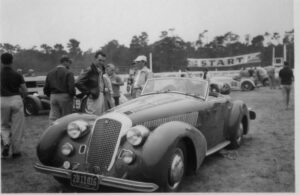
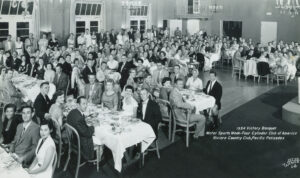
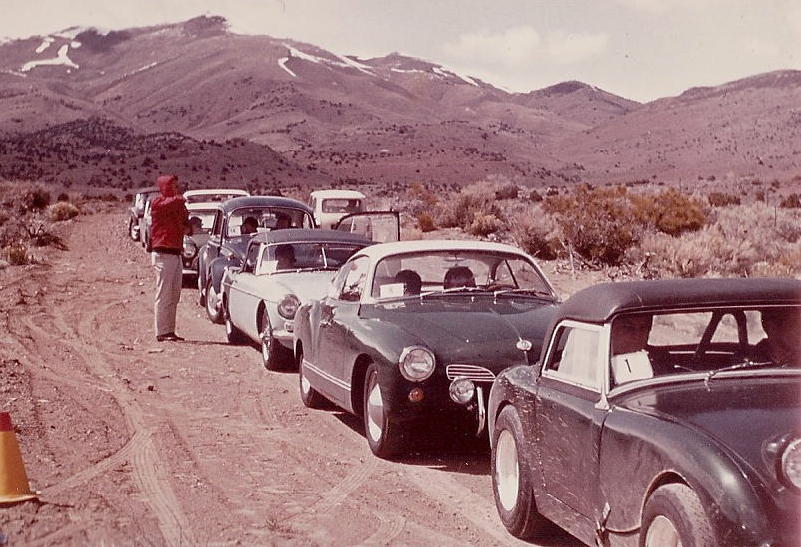
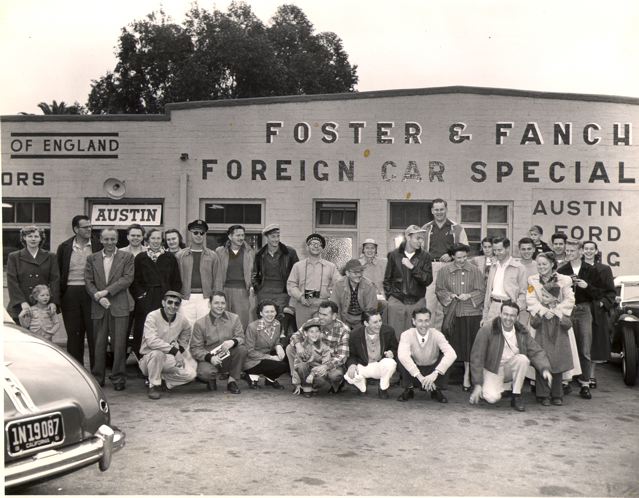
The post World War II period was a fascinating one for automotive enthusiasts. While all aspects of the hobby and sport grew in the late 1940s and early 1950s, arguably, none grew more passionately than the foreign and sports car movement.
One of the earliest and most successful of the clubs that formed around the invasion of foreign cars into the USA was the Four Cylinder Club of America. This organization began in Glendale, California ca. 1949-1950 and quickly grew into the largest non-racing sports car clubs in the U.S.A.
About This Website
FCCA History Project
The purpose of the Four Cylinder Club History Project is to gather as much information about the organization as possible, with the objective of documenting its history. Possible projects include the publication of a book on the Four Cylinder Club of America, the creation of magazine articles about the club, and the maintenance of this web site. The Four Cylinder Club of America was an important part of Post War automotive history, and this effort has been created to gather information and to help others learn about the role it played in automotive history.
What You Can Find
Browse our site contents via the navigation menu or the links below.
Do you have something to contribute?
FCCA History
Background and History
Photos
Images from Events and More
Regalia
Dash Plaques, Badges, Rally Gear, and More
FCCA Chapters
Information on FCCA Chapters
Documents
Printed Materials and Stories
Stories
Stories and Articles from Members and the Media
I have come across two old – and I do mean old – copies of Exhaust Notes. These are the club magazines, 30 pages long. Sept 1952, November 1952. Both are in great shape but the paper is faded a bit.
I’ll donate them to the club for shipping costs.
Martin Rudow
I have a couple of picture of the orginal members of the Wandering Wheel Motoring Club chapter of the FCCA based at NAS Moffett Field, Ca.1963. I may have a few copies of flyers from Racherfrachers (RSSCC) and Camig SCC chapters from San Jose area in the 1960’s. If I can find anything I’ll copy and send it to you.
Hi Louis
I would be most interested in copies of your materials. If you could scan the written material in the form of .pdf files and scan the photographs as .jpg files that would be great. I have no written materials from the Northern California chapters, so this material would add greatly to the archives. I have some business files from Wandering Wheels, but no photos. So, again, this material would be greatly appreciated. Let me know if you need assistance doing these scans.
Thanks!
Bill Wilkman
Bill: I just purchased a silver tray with a Four Cylinder Club of America emblem in the center at an antique store in Charleston, SC. It has a trophy shop sticker on the back from Los Angles. I can send pictures if you like and maybe someone can help identify the era and possible history of its orgin.
Regards,
Jim Phillips
Greenville, SC
I am looking for any information about a former member, Bill “Pat” Patrick. If there is any information available I hope that you would share.
I have many ralley plaques and dash plaques and will be happy to send pictures.
Thank you, Mike Patrick
Hi Michael. Where are you located? There are a couple of groups in Southern California that meet and discuss sports car racing in the 1950s and 1960s. One is a group that meets monthly in Burbank and the other is a larger group that meets at various places around Southern California. Contact me if you’d like more information on these groups. One of the people who belongs to both groups is Art Evans. Art has written several books on sports car racing in the 1950s and 1960s. Among them is The Fabulous Fifties. It has a whole chapter devoted to Santa Barbara, although it only includes one full list of entries, that for the first race in 1953. Let me know if you’d like Art’s contact information and I’ll pass it along. I would be most interested in learning more about your collection of regalia. Please provide more details as time allows.
Bill Wilkman
Does anybody remember racing at Santa Barbara?
My dad used to run Austin Healeys there
I was a member of Foothill FCCA (Glendale, CA area) in the 60’s (roughly 1967 – 1969). My buddy Randy Holst and I were still in high school. Most of the club was older. Monthly meetings were at a pizza parlor close to Glendale Community College. At the time I drove a 1959 TR3 and Randy had an Alfa Guilettia. The club included two Lotus Super Seven’s. One of the hot drivers of the club was a mechanic at Vasek Polak. I recall an amazing run over the Angeles Crest in his Porsche powered Karman Ghia.
Foothill FCCA put on Slaloms and Ralleys. We held many slaloms at Whiteman Airport. At the time there was an 1/8 mile oval with a banked turn. Cars would have a good run down a straight (the runway) then into the bank. We used to joke that every event would put at one Vette into the wall on the bank.
I am in the process of restoring an old Nardi steering wheel off an Abarth 750 I used to have. The wheel hung for decares in my garage with my FCCA badge mounted where the horn button belonged. There is some corosion on the chrome but no dammage to the enamel. After I finish the wheel I will see what I can do with the badge.
Best,
Ken Koll
Very interesting history, Ken. It’s always good to receive first-hand recollections of past Club activities. Thanks for sharing!
Bill Wilkman
FCCA Historian
ANybody know the whereabouts of John Johnson? He was one of the main members of Racherfrachers SCC and the one who designed most of the graphics, which ran a number of rallys in Santa Clara Valley before it became Silicon. I participated in lots of RS (Racherfrachers logo) rallys, along with Treadmasters and other SSC’s. I still have my first place mug for “Rally to the Pub”, and my 10th place expert plaque for “The Caped Crusader” rally. Used to have a bunch of other plaques which went by the wayside as I sold my cars and didn’t take the plaques off! Good memories. Best misleading concept was a rally that ran through the many side roads in the Santa Cruz Mountains, and the “Fire Danger” signs had small print that told anyone who noticed that the bonus checkpoint could be found by turning off a road on Highway 9. I think about three people noticed the small print. Still drive a roadster (M Power) and enjoy the memories
Sorry for the delayed response. I usually receive notices of postings. But, for some reason no notices have come through for the past several months. Your experiences with the FCCA sound like very happy memories. If you want to make contact with a couple of people who may know the whereabouts of John Johnson, email me at wilkmanracing@aol.com. I’ve saved many of my cars and have them in a collection. MGA, Bugeye Sprite, 1990 Miata, and others. I now drive a 2008 Miata, which I love and consider to be the best “MGB” ever produced!
I was a member of the four cylinder club here in Costa Mesa with my 1954 MG TD. We met at the women’s club on
Park and Placentia. We had a mix of Porches, MG and Aston
Healy’s. We had many road tours and were time trails through out OC. I do not know if I have any memorabilia.
Sorry for the delayed response. I usually receive notices of postings. But, for some reason no notices have come through for the past several months.I wondered why things were so quiet in FCCA-Land! Very cool to hear about your days with the Costa Mesa FCCA. You must have been one of the earlier members. If you ever run across any photos or memorabilia, please let me know at wilkmanracing@aol.com.
My wife’s Dad, Allyn Watkins, was a long time member of FCCA in Phoenix from early 50s to 60s. We have some memorabilia, and probably pictures of events, newsletters etc. He had a Mercedes 190 SL, and a Jaguar. A big event was the annual Jerome Hill Climb. Is there someone in Phoenix area that might be interested in this?
Sorry, Jim, for the very slow reply. My web site software is supposed to notify me of postings, but hasn’t done so for over a year. I am always interested in adding materials to the FCCA archives. If you would like to donate any of the items you mentioned, I would appreciate it and could reimburse you for postage. Just let me know if you are interested in doing this. My email is below.
Bill Wilkman
wilkmanracing@aol.com
I lived in Prescott Az. from 1948 till 1963 and went to a Hill Climb in Jerome Az. that I believe was sponsored by the 4 Cylinder Club. This was in the late 50`s. They ran from the old High School up the hill to the main street. I think it was a mile and 1/8th with 11 turns. There was a Dentist from Tucson that won the overall who drove a Lotus Valiant. The time was under a minute if I remember correctly. They stopped traffic and one car at a time would be on the course. It was very well run as I remember. The Vettes didn`t do well but the little Fiat Abarth Zagattos screamed. I`m 78 so I may be remembering things that never happened, but I have always wondered if the club was still in existence. I believe they stopped the hill climb for insurance reasons.
Sorry, Don, for the extremely slow reply. My web site software is supposed to notify me of postings, but it has not done this for over a year. Your memory is very good in relation to the Jerome Hill Climb. A friend of mine visited Jerome and there was a display about the rally in the local museum there. Thanks for your interest in this web site.
Bill Wilkman
FCCA Historian
This is a shout out to Lou Gross – how in the heck are you. Give me a toot at Jerrarieq@aol.com AND to Tom Clark – last time I heard Johnny Johnson was in Capitola, California (near Santa Cruz) @ (408)475-3951 – Dave James, Nor-Cal Rally Team
I have an 1951 MG TD that I bought in June this year, 2017. It has a 4 Cyl Club dash plaque which reads:
LEPRECHAUNS LAMENT
March 19, 1961
PARTICIPATION AWARD
Santa Clara Valley Chapter
I can send photo’s of the plaque and car if you would like. I am restoring the MG and hope to have it back on the road in the Spring of 2018.
Best regards, Roger.
Sorry for the slow reply, Roger. I didn’t notice your comment until I went to approve another comment. I’d love to see photos of the plaque and your car. In my collection, I have a 1960 MGA that has been in the family since new. It proudly wears an FCCA grille badge from back in the day.
Az FCCA died in 1983 after an almost 50 year run. Our one big moneymaker, the Clifton Hillclimb, was failing and parking lot autocoss/slaloms were oversubscribed. SCCA was taking over in Phoenix. A lot of the oldies are still alive and have lunch every first Friday at The Phoenix City Grill.
Thanks for your comment, Rob. The AZ chapter of FCCA was the most active chapter outside of California and maybe even more active than most or all of the So Cal chapters. FCCA was never very good about supporting its out of state chapters and many, especially those most distant from California dropped affiliation over the years. The final nail in the coffin came when the insurance carrier refused to cover any out of state chapters.
Just discovered your website. Belonged to Le Vivo Machine’ in the mid 1960’s. Many a rallye starting from Stanford Shopping Center in Palo Alto.
Nice to hear from you, Jeffrey. El Vivo Machine was one of the more active chapters.
Bill Wilkman
FCCA Archivist
I am very happy to work with Bill on this site!
I very much appreciate you attention to the FCCA web site, Corry. At some point this year I’ll want to add to the web site. I’ll be in touch with you for help in this regard.
Bill Wilkman
FCCA Archivist
I belonged to the Santa Clara valley chapter in the “60’S”. Used to rally all time. Started with MGTD then to XK120 super sport,Riley path finder,Corvette stingray then moved out of the area still have dash plaques and trophies along with the members badge. Loads of fun!!!!
Hi Dennis. I looked in the archive and found a very full file on the Santa Clara Chapter. Among the items in the file is a membership application from you, listing your car as a Corvette. According to the file, the Santa Clara Chapter changed its name to the Ramblin’ Rogues in the mid-1960s. Also in the file is a club newsletter named the Quip Board. It appears to be from approximately 1962. If you ever want to part with your FCCA artifacts, I’d be interested in adding them to the archive.
As A former member of NCRT (Nor Cal Rally Team), I’m delighted to read comments from fellow NCRT meber Dave James. Been on rallys put on by Le Vivo Machine, Rambling Rogues, Wandering Wheels, RS (Racherfrachers), FTC, OSCA, and too many other bay area clubs to remember. My brother Dan Van Dan and my HS classmate Dennis Hall were members of Wandering Wheels. Once served as Chairman of The Greater Bay Area Region of FCCA. RS and then NCRT used to put on some fabulous Halloween rallies up in the Santa Cruz Mtns. Johnny Johnson was our go to guy for rally flyers. I have a few of his original work-up posters that were photographed and printed as flyers. Dang, those were the hey days of car rallies.
Hi Jim. So nice to hear from you. David James has been very helpful supplying me with a large quantity of dash plaques, a couple of FCCA jackets and other items. Lou Gross of Wandering Wheels provided me with a large number of FCCA newsletters. You may be aware that Johnny Johnson passed away a couple of years ago. His wife provided me with a large number of his highly creative artworks. I think I have a photo of you with a pickup truck equipped with an FCCA sign. Is that you?
My husband and I were members of the San Fernando FCCA chapter in 1956 with our 65 MG. 1500. We used to meet at the Reseda Bowling Alley monthly. Our chapter had a good representation of members from Rocketdyne. We were gung ho ralliests, and frequently hosted rally’s. Ernie Healy was a member, and he designed very complicated tours all over LA. My husband also designed rally’s, and they were pretty tough also. Annually several of us did the 24 hour rally’s up and down Southern California in our little 1950 Healy 4 door wagon, carrying our 2 small kids in the back .
Thanks, Molly, for sharing your history with the San Fernando Valley Chapter. You were probably a member when John Foster was President. If you have any photographs from that era of FCCA history, I would be interested in borrowing them to scan them into the FCCA archive.
Dear Bill:
/I should never try emailing in the middle the night! I made a typo – my MG 1500 was a 1955, Not 1965… by the way, i tried filling out the register page by was locked out. Any suggestions?
I’m thinking your Healey was 4 seat roadster, not a 4 door wagon. Correct? Unfortunately the register part of the web site is not working. I keep track of everyone who contacts me though, so in effect, I have my own register.
Bill
I have a Four-cylinder club of America badge for sale. Any interested persons Kole area code 425-931-7049 thank you
Hi Johnny
I’d suggest you list the badge on eBay.
Hi
Does the club still have windshield stickers
No, I’m afraid those are no longer available. The Club ceased to exist in the mid-1990s.
Bill Wilkman
FCCA Archivist
WINDSHIELD DECALS NOW AVAILABLE. I have made reproduction water slide decals of the club’s logo. If you’re interested in obtaining one, email me at wilkmanracing@aol.com
My Grandfather, Thomas Ernsberger was director of the Glendale FCCA in 1958. He was a member for many years. I have found many badges/pins of the different rallies the group participated in. Let me know if interested.
Hi Sorry for the slow reply. I’ve had trouble accessing through web site for some time. Please contact me at wilkmanracing@aol.com so we can communicate more freely. I’d be most interested in learning about what you have found.
I am looking for any help that someone may be able to give me I own a 1958 Porsche 356 Speedster serial number 84039 that was del to Competition Motors in Calif. on 12/31/1958.
The car was Ruby Red and race in SCCa events in the area I think the gentlemen that may have owned this car was in the medical field. I purchased the car on 9/2/1995 from a gentlemen from Tulsa.Okla a Mr. Tom Davis who could not remember the man’s name who he bought the car from.I found a tag that says the license or cf number is BNS703 and the vehicle ID number is 504 and a MO27331-T and a sticker number T7272427 also I have a Porsche key ring from a shop that may have serviced the car European Auto Service 1163 Francisco Blvd San Rafael, Ca 94901 indicates that they were a Porsche and VW service center phone number 415 456 4999 I am trying to find out the history of the car any help that someone can give me would be much appreciated.Thank you Best Regards Phil Gumpert Indiana 317 432 0414 cell